The -42% math anomaly on Apple calls
I want you to look closely at how options actually price themselves when a mega-cap stock like Apple experiences a brief, minor pause.
It is a math phenomenon that average retail accounts completely miss because they are too busy looking at standard stock charts.
When a liquid giant like AAPL pulls back just a tiny bit, the options market often causes call premiums to drop twice as fast as the stock itself.
This temporary disconnect creates a unique pocket where high-quality contracts sell at a deep markdown.
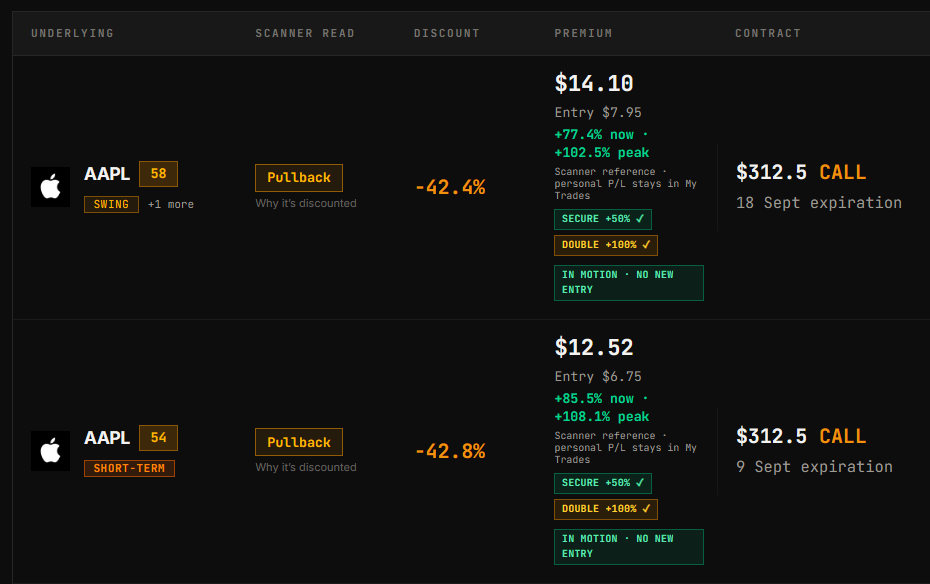
Look at the actual scanner log from our system where AAPL pulled back and triggered a massive -42% discount on the $312.50 strike calls.
The scanner flagged the entry zone at $7.95 for the swing contract, and $6.75 for the short-term contract, before the premium snapped back to peak gains of +102.5% and +108.1%.
This is exactly why I stopped buying options at normal prices and built a systematic engine to search exclusively for these pricing dislocations.
I just put together an on-demand training presentation where I walk through the entire 5-step engine we use to scan, filter, and score these discounted setups.
You can watch the complete on-demand video breakdown here to see the mechanics behind this pricing structure.
This training shows you exactly how we screen out garbage penny stocks, avoid illiquid options, and identify the exact moments when a premium is genuinely discounted rather than just cheap.
We also dive into real case studies like Shopify, GM, and DoorDash where this exact structural displacement triggered massive recoveries.
If you want to learn how to identify these asymmetric risk windows without chasing inflated premiums at the top of a run, this training was built for you.
Watch the Discount Options Presentation Now
There is no cost to watch this, and you can stream the full breakdown immediately at your convenience.
Talk soon,
Ben | Find Better Trades
P.S. Make sure you pay close attention to step three of the engine, which explains why the pricing model behaves so erratically on high-quality stocks during sector rotations. Click here to stream the training now.