The Ultimate Guide to Trading Volume Node Breakouts with Fixed Range Volume Profile
The Game Has Fundamentally Changed
If you feel like you are constantly fighting the market, let us be the first to tell you: it is not your fault. It feels like the market is rigged against you because, in many ways, it is.
We are no longer trading in the days of the open outcry pit where human emotion drove every tick. Today, you are trading against multi-million dollar institutional algorithms and High-Frequency Trading (HFT) bots. According to industry data, roughly 70% to 80% of all daily US equity market volume is now completely driven by algorithmic trading and machines.
The market spends 80% of its time going absolutely nowhere, trapped in tight, volatile ranges. Why? Because institutions are building massive positions inside these tight, high-volume consolidation zones. They want retail traders to step in early. They literally need your liquidity to fill their massive orders.
If you are relying on lagging indicators like traditional Moving Averages, the MACD, or RSI, you are playing right into their hands. Those tools only tell you what happened yesterday. They can’t tell you where the volume is trapped right now.
To survive and thrive in today’s algorithmic battlefield, you need an X-Ray of the market. You need to see exactly where institutions are hiding. You need the Fixed Range Volume Profile and an understanding of Volume Nodes.
What is the Fixed Range Volume Profile?
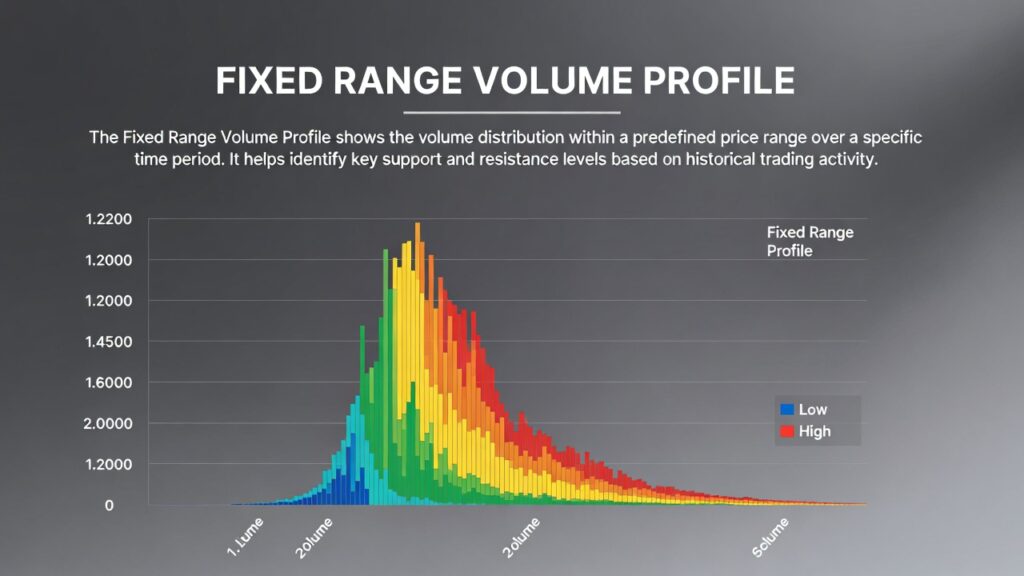
Most retail traders use traditional volume—the vertical bars at the bottom of the chart. Traditional volume tells you when buying or selling occurred. While helpful, it misses the most crucial piece of the puzzle: where the volume was transacted.
The Volume Profile flips this concept on its side. Instead of plotting volume over time (the X-axis), it plots volume over price (the Y-axis). A Fixed Range Volume Profile (FRVP) allows you to draw this profile over a specific, custom period—such as a recent consolidation phase, a daily session, or a major swing leg.
When you apply the FRVP to your chart, it creates a horizontal histogram that reveals the market’s true structure. You will immediately notice peaks and valleys in the profile. These are the footprints of smart money.
Understanding High Volume Nodes (HVNs)
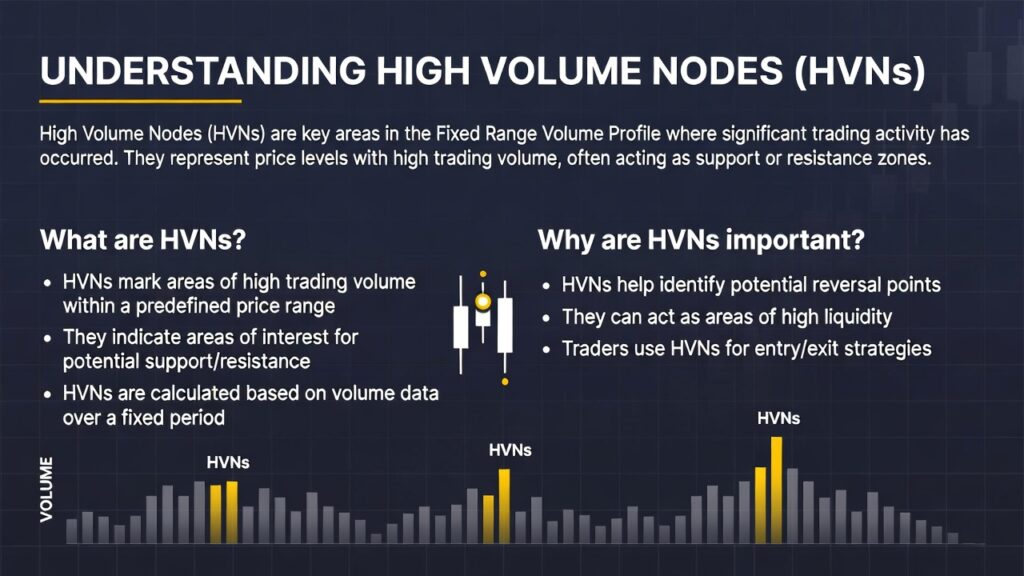
The peaks protruding from the Volume Profile are called High Volume Nodes (HVNs). An HVN represents a price level where a massive amount of historical trading activity took place.
Think of an HVN as a “Gravity Trap.” Institutions cannot buy $500 million worth of a stock all at once without spiking the price and ruining their average entry. Instead, they use VWAP (Volume-Weighted Average Price) algorithms to quietly chop up their orders over days or weeks within a specific price band. This heavy accumulation creates an HVN.
Price gets pinned in these tight ranges while the bots absorb shares. HVNs act like magnets or black holes; they pull price in and hold it there. This is where the dreaded “chop” happens.
Understanding Low Volume Nodes (LVNs)
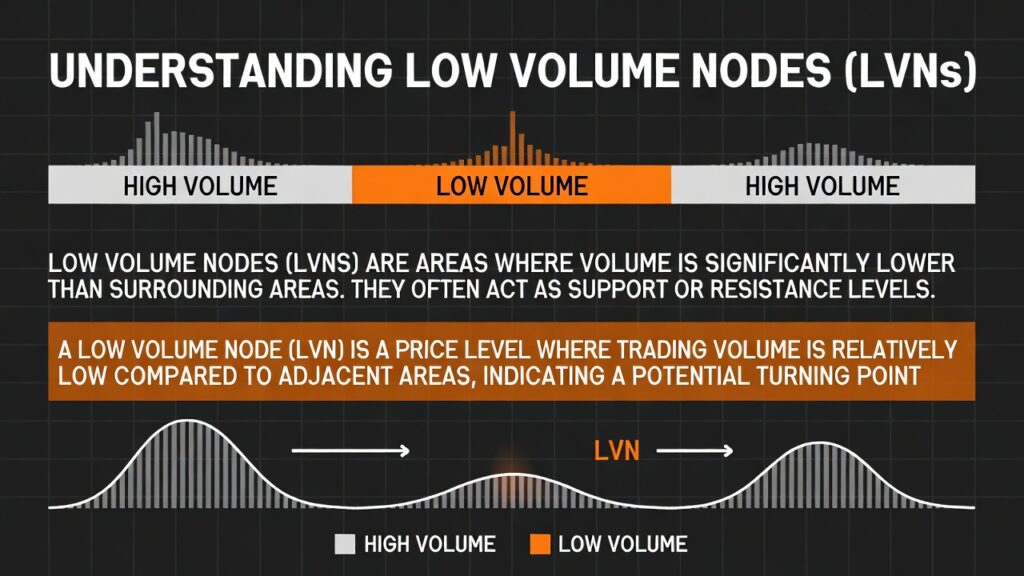
The valleys in the Volume Profile are called Low Volume Nodes (LVNs). An LVN represents a price level where very little trading occurred. Price blasted through these levels in the past because there was no historical interest or liquidity to slow it down.
If an HVN is a thick, muddy swamp, an LVN is a freshly paved, frictionless highway. When price enters an LVN, it tends to move rapidly. There is no “gravity” to hold it back.
The Anatomy of the Retail Liquidity Trap
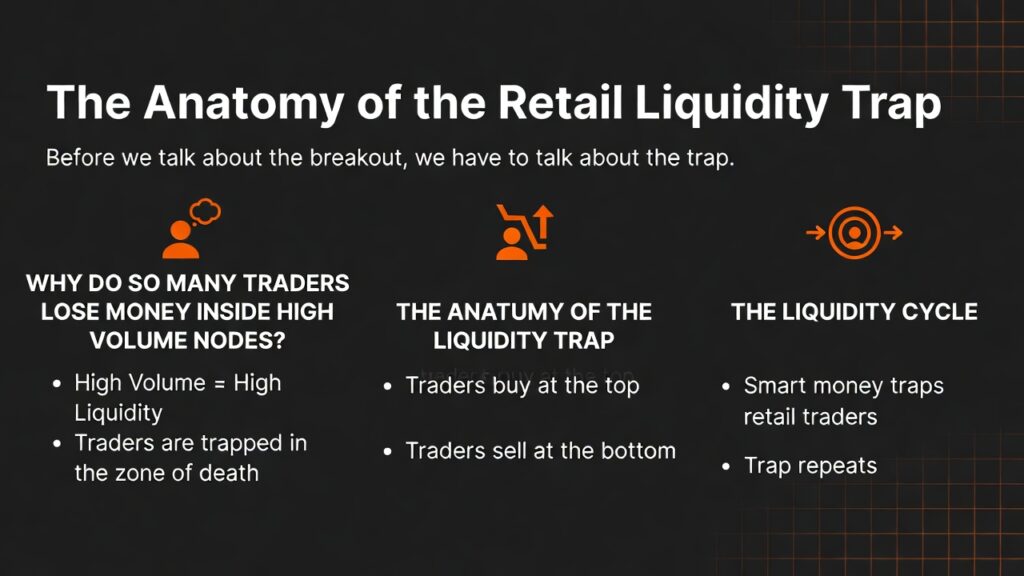
Before we talk about the breakout, we have to talk about the trap. Why do so many traders lose money inside High Volume Nodes?
It comes down to liquidity hunting. When an algorithmic bot needs to fill the last leg of a massive institutional order, it needs a counter-party. It needs sellers so it can buy. Where does a massive pocket of retail sell orders sit? Right below the consolidation support line, in the form of retail stop-losses.
The algos purposefully push the price just below support to trigger the retail stops. They scoop up your shares on the cheap, fill their order, and immediately rip the price higher without you. You get stopped out for a loss, only to watch the asset rip in your direction 15 minutes later.
This is the psychological warfare of the Gravity Trap. The solution? Stop trying to trade inside the trap. Wait for the institutional accumulation to finish, and trade the escape.
The Volume Node Breakout Strategy
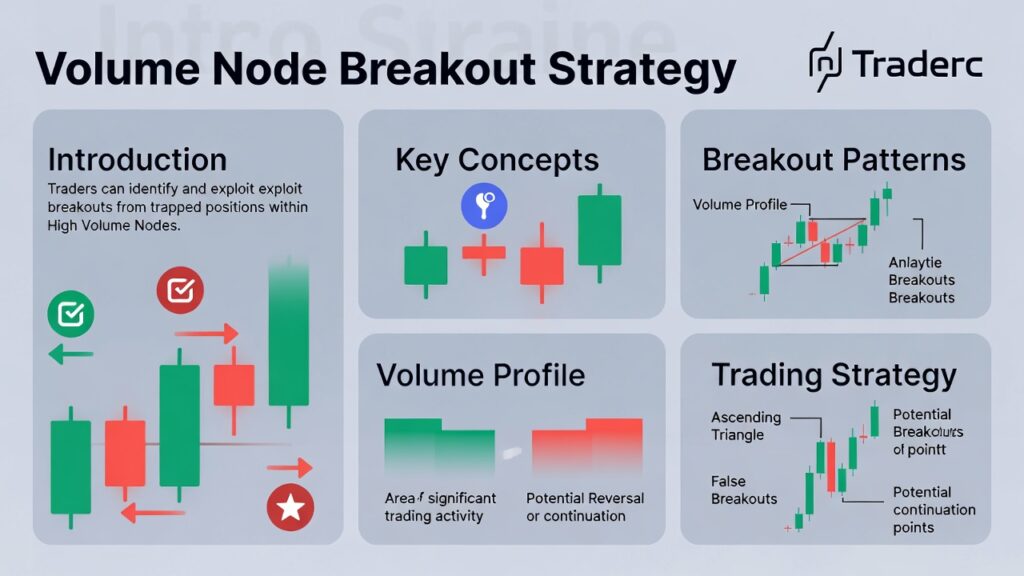
The core philosophy of this trading strategy is patience and structural awareness. We do not want to predict the bottom. We do not want to guess when the accumulation is over. We simply want to wait for the market to prove that the “Gravity Trap” has been broken, and then ride the momentum into the frictionless open space of a Low Volume Node.
Here is the manual way to trade this strategy:
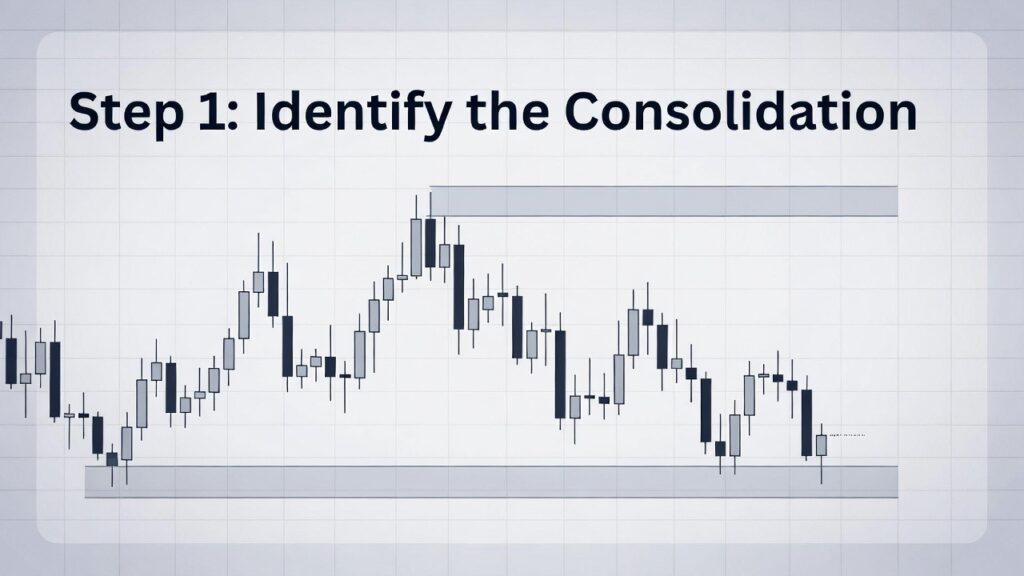
Step 1: Identify the Consolidation Look for a market that is moving sideways. This is your potential accumulation or distribution zone.
Step 2: Anchor the Fixed Range Volume Profile Draw your FRVP tool from the start of the sideways movement to the current candle.
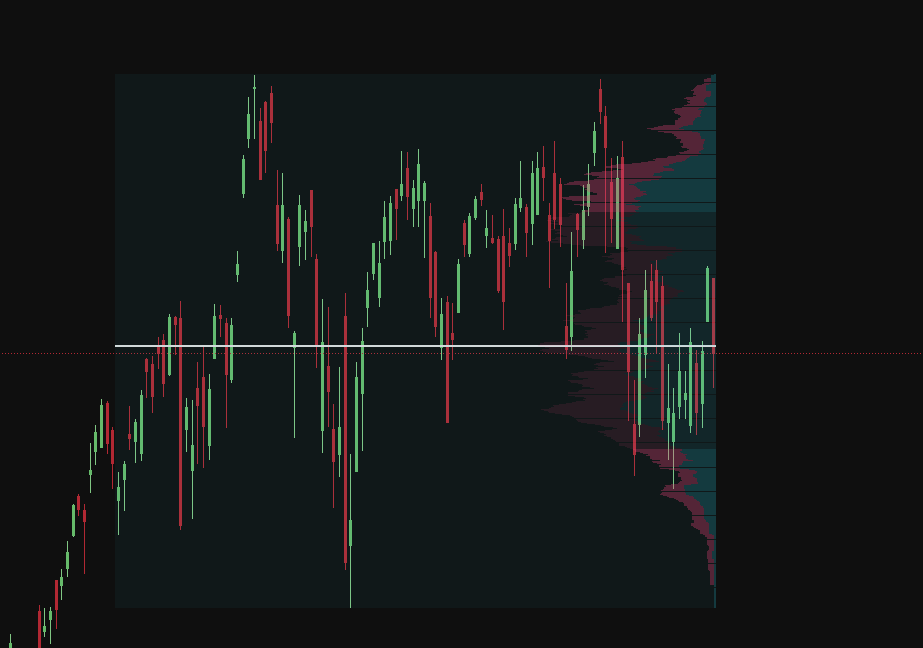
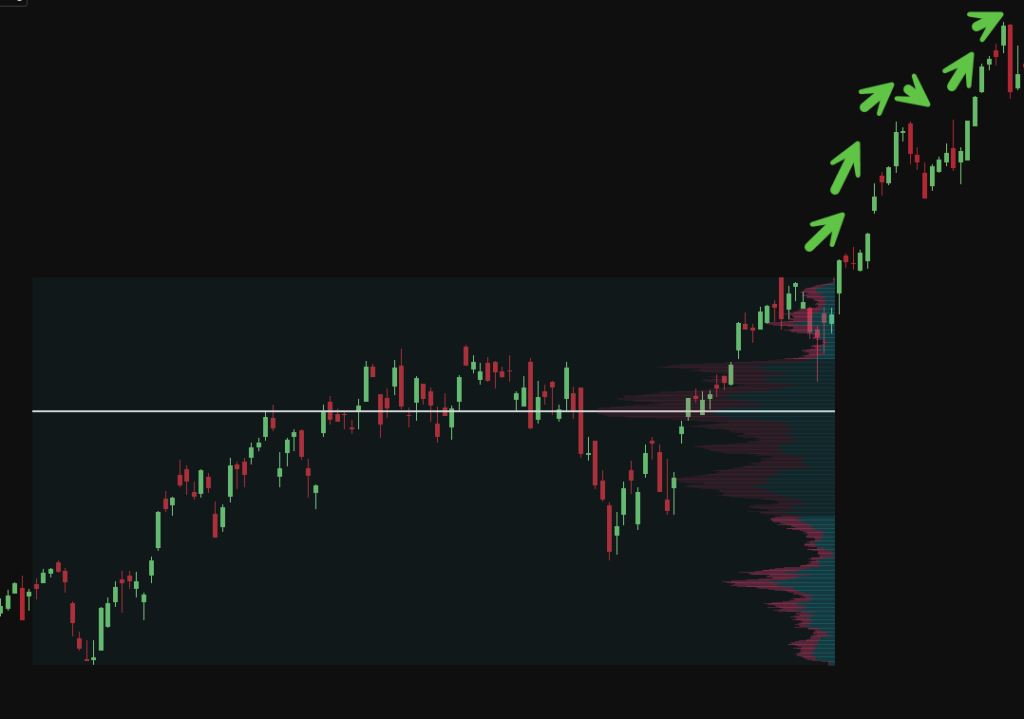
Step 3: Map the High Volume Node Identify the thickest part of the profile (the HVN). Mark the upper boundary and the lower boundary of this node. This is your “No Trade Zone.”
Step 4: Locate the Open Space (LVN) Look above and below the HVN. You are looking for a significant drop-off in the volume profile—an area where the histogram shrinks dramatically. This is your target zone.
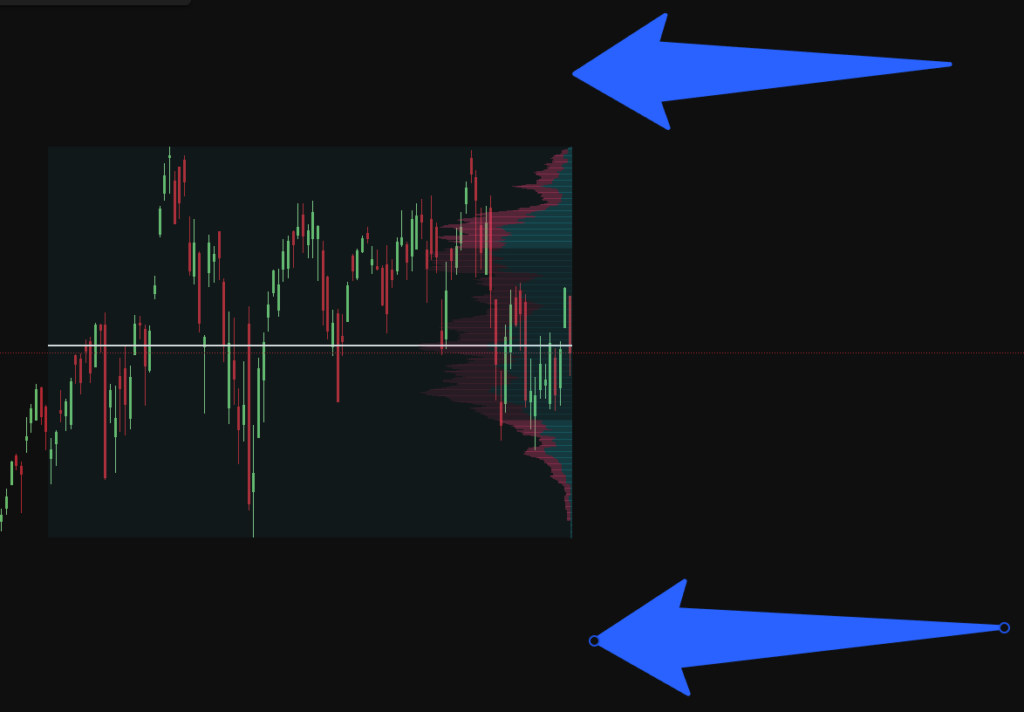
Step 5: Trade the Escape Wait for a strong, high-momentum candle to close outside the boundaries of the HVN. If it breaks the upper boundary, you buy, targeting the next historical HVN through the frictionless LVN space. Your stop loss goes safely tucked just inside the middle of the previous HVN, protecting you from whipsaws.
The Problem with Manual Volume Profiling
While the theory behind Volume Node breakouts is bulletproof, the manual execution is exhausting.
Drawing levels manually is subjective. Where exactly do you start the Fixed Range tool? Where does the node officially end? If you draw it slightly off, your entire thesis is compromised. Furthermore, manually managing these profiles requires you to stare at a screen all day long, constantly adjusting your anchors as new price action develops.
If you are manually drawing lines, you are still at a severe disadvantage against the algorithms that process structural data in milliseconds.
But what if you could automate the entire process?
Introducing the Gravity Zone Indicator by FindBetterTrades

At TradingStrategyGuides, we review hundreds of tools, but very few fundamentally change the way we view the charts. Recently, we discovered an absolute game-changer created by Ben at FindBetterTrades.
Ben, a trader who was tired of being chopped to pieces by algorithmic traps, spent hundreds of hours studying institutional volume. Recognizing the power of Volume Profile but hating the subjective, manual labor involved, he coded a fully automated solution.
The result is the Gravity Zone Indicator.
Gravity Zone isn’t just an indicator. It is a dynamic, fully automated Volume Engine that mathematically maps institutional structure for you in real-time, completely hands-free. It takes the complex concept of Fixed Range Volume Profile and distills it into a dead-simple, highly visual system.
Let’s break down exactly how this tool automates the Volume Node Breakout strategy, allowing you to ignore 80% of market noise and only trade frictionless escapes.
Step 1: Identifying the “Blood Red Trap”

When you load Gravity Zone onto your TradingView charts, the system automatically runs a continuous calculation of the volume structure. When it detects that institutions are building positions and trapping price, it literally boxes the consolidation phase in a Blood Red Trap.
You no longer have to guess where the High Volume Node is. Gravity Zone calculates the exact shelf and visually warns you: This is the Gravity Trap. Do not trade here. You simply sit on your hands and protect your capital while other retail traders get chopped up.
Step 2: Firing the “Teal Breakout”

No more guessing if a breakout is real or just another stop hunt. Gravity Zone waits patiently for the algorithms to finish accumulating. The very second price breaks out of the institutional trap and crosses into open space, the system springs into action.
It verifies the volume momentum, paints your breakout candle a bright TEAL, and drops a crystal-clear entry arrow directly on your chart. This is the visual confirmation that the asset has achieved “Escape Velocity.”
Step 3: The “Options Scout” HUD Targeter (The True Game Changer)

Here is where Gravity Zone elevates from a great charting tool to an absolute must-have for options traders.
Once that Teal signal fires, you don’t have to waste precious time scrolling through complex options chains trying to calculate Greeks, implied volatility, or Delta. Built directly into the top right of your chart is the Options Scout HUD.
When the breakout occurs, the HUD auto-calculates the exact option contract strike price and expiration date to play for maximum leverage.
The HUD features three distinct states to remove all ambiguity:
- ⚖️ RANGE BOUND (Yellow): Price is stuck inside the institutional trap. Keep your capital safe.
- 🟢 LOCKED BULL / BUY (Green): Price has successfully broken above the gravity trap. The HUD flags a BUY status and feeds you the exact Call option contract.
- 🔴 LOCKED BEAR / SELL (Red): Price has broken below the floor of the trap. The HUD flags a SELL status and feeds you the exact Put option contract to profit from the downside drop.
>> Click Here to See the Gravity Zone HUD in Action <<
Real-World Case Studies: The Power of the Escape
Let’s look at how the Gravity Zone indicator applies the Volume Node Breakout strategy across different assets and timeframes.
Case Study 1: The Frictionless NVIDIA (NVDA) Escape

For weeks, retail traders were getting chopped to pieces trying to guess the bottom on NVDA. They kept buying the dip, only to get stopped out as algorithms hunted their liquidity inside the Gravity Zone.
Gravity Zone saw exactly what the institutions were doing and kept traders out of the chop. Finally, NVDA broke out of the trap. The system painted a Teal Candle and dropped a Buy arrow. Instantly, the Options Scout HUD calculated the perfect contract: The $185 Call (11/28).
Because there was no “Gravity” (High Volume Node) left to hold it down above that level, NVDA broke directly into the open space of an LVN and never looked back. The recommended contract yielded a massive 165% gain in a matter of days. A simple $1,000 investment would have handed you back $2,650 without breaking a sweat.
Case Study 2: Lower Timeframe Scalping on the S&P 500 ETF (SPY)

The strategy isn’t just for long daily swing trades; it works phenomenally on intraday charts because algos operate on all timeframes.
Recently, the system caught a perfect lower-timeframe breakout on the SPY. Price was boxed into a red trap, broke out, printed a Teal candle, and the HUD targeted the nearest Friday expiration for maximum leverage: The $685 Call (12/26).
The index sliced right through the open space, delivering a lightning-fast 108% gain before the end of the week. That is a clean, stress-free “bagger” on a major index.
Case Study 3: Crushing Crypto with Bitcoin (BTCUSD)

What if you don’t trade stocks or options? Gravity Zone never sleeps, making it perfect for the 24/7 Crypto markets.
When Bitcoin formed a massive trap at its local highs, Gravity Zone mapped the distribution phase. The second it broke the Red Sell Level, the HUD locked in a Bearish signal (automatically switching to Spot/Asset mode since options aren’t required here).
The result was an absolute avalanche—a staggering 20.54% raw asset drop from the exact entry point. If you were trading crypto futures with even 10x leverage, that is a 200%+ account-making trade on a single setup because you traded the escape from the volume node.
Case Study 4: Forex Domination on GBP/USD

Forex traders know how brutal algorithmic chop can be in the currency markets. When the British Pound broke the Gravity Zone’s Buy level, the HUD immediately locked the entry into open space.
The pair ripped higher for roughly 300 pips. Trading just one standard lot, that translates to approximately $3,000 in pure profit on a single currency pair breakout.
Why You Need to Adapt Today
The days of drawing a simple trendline and hoping for the best are over. If you don’t adapt to tracking volume structure, AI bots and institutional algorithms will continue to use your trading account as their personal ATM.
You need a system that:
- Keeps you out of the 80% of market noise (The Trap).
- Alerts you the second institutional accumulation is over (The Escape).
- Tells you exactly what vehicle to use to maximize your profit (The HUD).
By automating the Fixed Range Volume Profile, the Gravity Zone indicator does exactly this. It requires less screen time and results in vastly reduced stress. You don’t need to wake up at 4 AM to read the news. You don’t need to care what the Federal Reserve is doing. You just let the algorithm map the chart, and you trade the escape.
Exclusive Offer: Become a Founding Member

Normally, institutional-grade tools that calculate real-time volume structure cost thousands of dollars a year in subscription fees.
However, right now, Ben at FindBetterTrades is looking for a small, dedicated group of “Founding Members” to lead the charge. By getting in early, you can secure the entire Gravity Zone system for a fraction of the retail cost.
Here is exactly what you get:
- The Gravity Zone Indicator for TradingView: Lifetime access to the dynamic volume profile script.
- The Gravity Zone Masterclass: Step-by-step video training on institutional execution.
- Gravity Zone Settings Guide: Replicate Ben’s exact chart setup.
- The Dead-Simple Options Guide: Learn exactly how to execute the contracts the HUD feeds you.
- The Universal Trading Guide: How to use the system on Crypto, Forex, and standard shares.
- BONUSES: The Options Scout HUD, TradingView 101 Basic Course, Recommended Brokers Guide, and the Ultimate Breakout Checklist.
Standard retail pricing for this suite is $1,997 per year. But right now, you can become a Founding Member for a one-time payment of just $277.
- ❌ NO SUBSCRIPTION FEES
- ❌ NO UPDATE FEES
- 🛡️ Backed by a 30-Day “Open Space” Money-Back Guarantee.
If you are ready to stop guessing where the market turns and finally start trading frictionless escapes, you need this tool in your arsenal.
👉 CLICK HERE TO CLAIM YOUR GRAVITY ZONE LIFETIME PASS AND ESCAPE THE CHOP
To your success,
Trading Strategy Guides